If you struggle with casting the club, coming over the top, or stepping up to the first tee feeling stiff and out of sync, you are not alone. Timing and lag are two of the most elusive fundamentals in golf. Without proper lag—the angle maintained between your lead forearm and the club shaft on the downswing—you leak clubhead speed, hit weak fades, and struggle with inconsistent contact.
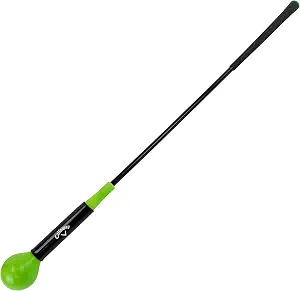
The Callaway Golf Swing Stick Lag Trainer is engineered to eliminate these mechanical faults. By combining a flexible shaft with a counter-weighted head in a practical 37.5-inch profile, this training aid forces you to wait for the clubhead, smooth out your transition, and build repeatable rhythm before and during your rounds.
Key Features & Design
1. Dynamic Flexible Shaft for Real-Time Feedback
The core technology behind the Callaway Lag Trainer is its exaggerated shaft flex. Unlike rigid clubs that let you muscle through an erratic downswing, this flexible shaft bends noticeably under swing load. If you rush from the top or cast your hands early, the stick will wobble erratically, immediately alerting you to a flawed transition. To swing it smoothly, you have to initiate the downswing with your lower body and let your hands drop into the slot naturally.
2. Weighted Head for Muscle Conditioning
At the end of the shaft sits a balanced, weighted ball. This counterweight serves two key functions: it stretches out the golf-specific muscle groups (shoulders, lats, and core) and provides the kinetic feedback necessary to feel the release point at the bottom of the swing rather than at the top.
3. Practical 37.5-Inch Length
Many tempo sticks on the market measure 45 to 48 inches, mimicking the length of a driver. While great for distance training, longer sticks are tough to swing indoors and can lead to over-swinging. Callaway built this lag trainer to match standard 6-iron dimensions (37.5 inches). This compact length allows you to practice normal iron posture, make full swings in rooms with standard ceiling heights, and easily slide it into your golf bag without it towering over your woods.
Performance & Practical Evaluation
Fixing the 'Over the Top' Transition
The single most noticeable benefit of this lag trainer is how quickly it cures a jerky transition. When you start your downswing with your upper body, the weighted end lags behind and exaggerates the error, throwing off your balance. After just 10 to 15 deliberate swings, your body instinctively learns that starting the downswing with the hips creates the effortless whip effect required for maximum lag and ball compression.
Pre-Round Warm-Up Routine
Arriving at the course with only five minutes before your tee time is a recipe for a ruined front nine. The Callaway Swing Stick functions as an outstanding on-deck warm-up tool. Swinging it back and forth continuously in a rhythmic, pendulum motion loosens tight back muscles, warms up your rotator cuffs, and grooves your natural tempo without the pressure of striking a ball.
Grip and Durability
The trainer features a standard, durable rubber grip that mirrors regular golf clubs. It feels natural in the hands, avoiding the bulky, unnatural molded grips found on some alternative training tools. The composite shaft is built to withstand high-repetition practice sessions without degrading over time.
Technical Specifications
| Feature | Specification |
|---|---|
| Brand | Callaway Golf |
| Product Type | Swing Tempo & Lag Trainer |
| Length | 37.5 inches (Equivalent to a standard 6-Iron) |
| Grip Type | Standard Golf Training Grip |
| Shaft Material | High-Flex Composite |
| Target Areas | Swing Lag, Tempo, Flexibility, Release Timing |
| Price | $49.99 |
Comparisons & Alternative Options
Depending on your practice environment and specific swing flaws, here is how the Callaway Lag Trainer compares with other popular training aids:
1. Callaway Golf Swing Stick vs. Amazon Basics Swing Trainer
If you prefer a full-length driver-style stick, the Amazon Basics option offers a 48-inch flexible shaft that emphasizes pure swing speed and upper-body stretch. However, the Callaway stick's 37.5-inch length makes it far superior for indoor practice and iron swing mechanics.
2. Callaway Golf Swing Stick vs. Retractable Swing Trainers
If ultra-portability and storage space are your main concerns, telescopic swing aids with built-in grip formers offer a compact alternative. While retractable trainers are convenient for travel, they do not replicate the fluid bend and authentic lag feedback provided by Callaway's one-piece flexible shaft.
3. Combining with Connection Aids
To maximize the effectiveness of the Callaway Lag Trainer, pairing it with a simple arm-connection band can help prevent 'flying elbows' while you work on your timing and lag.
Who Should Buy the Callaway Lag Trainer?
- High-to-Mid Handicappers: Golfers who cast the club early, lose clubhead speed, or struggle with a steep 'over-the-top' swing.
- Time-Crunched Players: Golfers who frequently arrive at the first tee cold and need a reliable, 3-minute warm-up aid.
- Indoor Practice Enthusiasts: Anyone looking for a tempo stick short enough to swing safely in a living room, garage, or office with standard 8-to-9-foot ceilings.
Who Might Want to Look Elsewhere?
- Players looking to hit actual golf balls while training (this is a swing-only stick with a round weighted bulb, not an impact trainer).
- Golfers strictly focused on overspeed training systems rather than tempo and flexibility.
Final Verdict
The Callaway Golf Swing Stick Lag Trainer delivers excellent value at $49.99. It bridges the gap between a daily flexibility warm-up stick and a serious swing-mechanics trainer. Its mid-iron length is a massive advantage over oversized 48-inch whips, making it versatile for indoor winter practice and easy to store right in your golf bag. If you want to stop casting, build real downswing lag, and find a consistent tempo, this is one of the most reliable training aids you can own.
BirdieFinder.Golf is a participant in the Amazon Services LLC Associates Program, an affiliate advertising program designed to provide a means for sites to earn advertising fees by advertising and linking to Amazon.com.